Michael Lyons
February 17, 2003
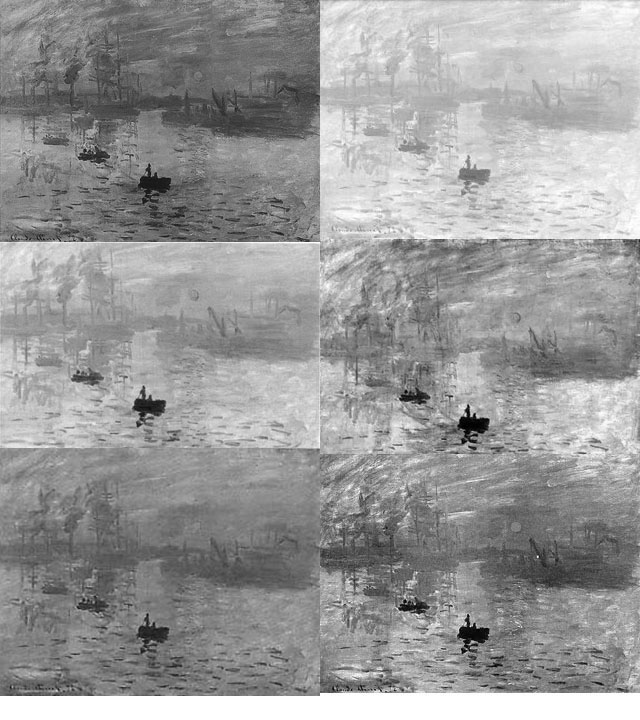
This news item describes a study of Claude Monet's famous painting Impression: Sunrise, by neuroscientist Margaret Livingstone. The Impressionist movement took its name from this painting. Livingstone, points out that the striking appearance of the rising sun in Monet's painting is mainly due to colour contrast: luminance contrast is extremely low. Though it is unlikely that much of Livingstone's message has made it into the article, it sounds like she is suggesting that this causes the sun to appear to shift and flicker in the painting, a possible consequence of separated processing of 'what' and 'where' channels by the visual system.
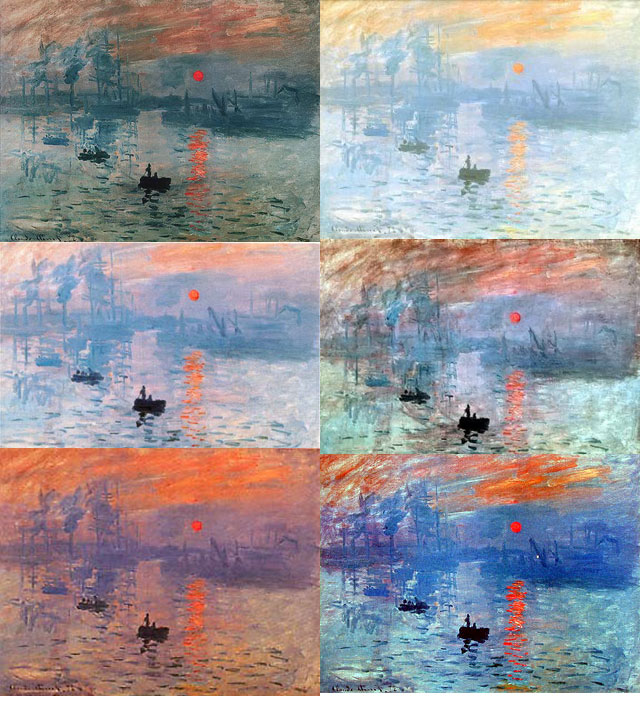
I did a Google image search for Monet's painting. Though I expected some variation in the colour representation of images from difference sources, I was surprised to see just how much colours vary between images from difference sources. Oddly, two of these images (top right and middle left panels) are from the web page of the Musée Marmottan Monet, in Paris, where the painting is kept . The composite below shows just a few versions of Monet's Sunrise available on the web:
Looking at the gray levels in theseimages largely confirms Livingstone's statement: